Tipping Point for a Hollow Earth | Reviewed By Nicole Yurcaba for The US Review of Books
Home » Tipping Point for a Hollow Earth | Reviewed By Nicole Yurcaba for The US Review of Books
HEAR FROM THE BOOK EXPERTS
In partnership with Bookside Press
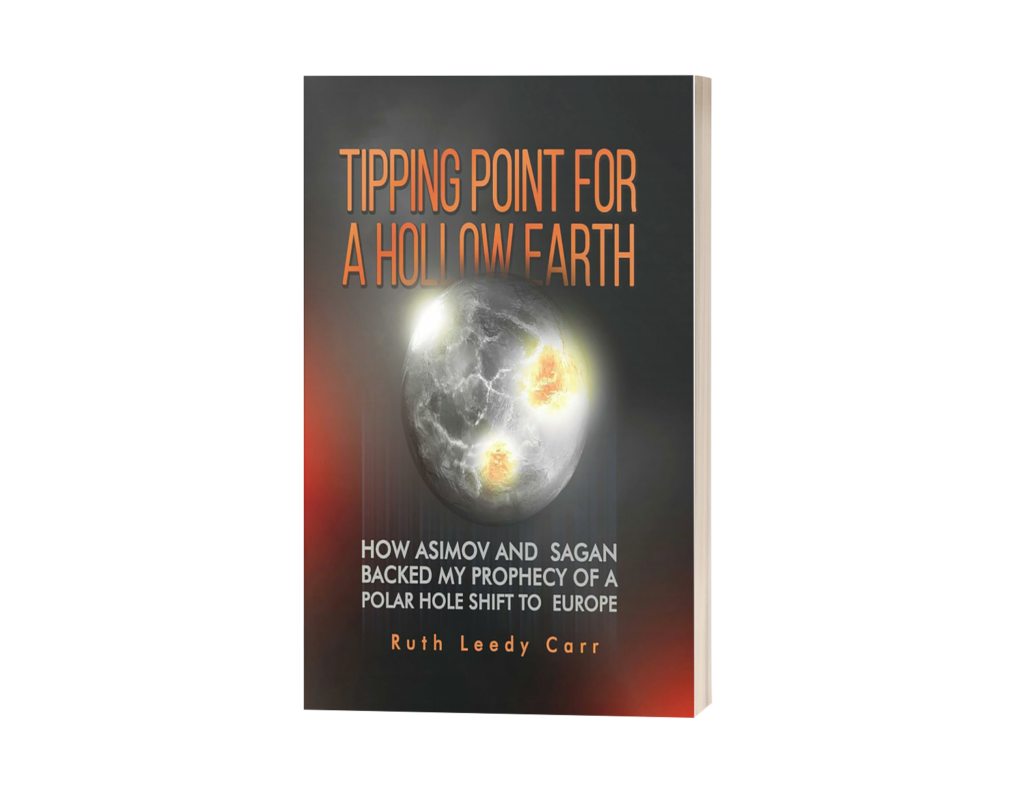
Tipping Point for a Hollow Earth
Ruth Leedy Carr
Reviewed by: Nicole Yurcaba, The US Review of Books
“And yet, Asimov lets us know in dramatic fashion that there is a secret star destined to head for Earth, and he shows us where that star is.”
It incorporates ideas from Isaac Asimov’s science fiction. It also explores prophecies made by Edgar Cayce regarding Earth’s axis shift. At certain points, the book incorporates elements from the Christian tradition about the Second Coming and alludes to an idea asserting that Christ knew that the Earth was hollow. Eventually, the book discusses theories about a hollow Mars and how both the Earth and Mars possess polar holes. A significant portion of the book talks about how NASA officials have deceived the public about what actually exists in the solar system and specifically about Mars’ hollowness. These ideas culminate as the author argues that theories hidden in novels and prophecies should be seen as “a wake-up call” for all of humanity.
The ideas in this book about Asimov’s work offer an interesting kind of literary analysis. The author dissects various symbols and even name meanings to unearth a secret code about the secret star destined to head for Earth. The in-depth analysis deepens as the author unpacks Isaac Asimov’s super riddles and asserts that, after the author sent Asimov a copy of her book, the riddles are easily associated with her. The author’s admiration for Asimov’s work is also clear. At one point, she describes Asimov’s work as “a gift that kept on giving decade after decade, giving with courage and determination,” because Asimov could reach millions of people. Similarly, the author’s discussion about Carl Sagan’s ideas and works is filled with admiration, and the development of the ideas about his works shows that the author has invested a lot of time and a lot of thinking into Sagan’s theories.
Carr’s book challenges various notions of truth, ultimately posing the question “What is truth?” Initially, these challenges to publicly perceived truths emerge in the author’s ideas about NASA’s various public deceptions. As the book segues towards its conclusion, the author states, “The truth is not hard to see, but it is hard for the truth to prevail against opposition, indifference and fear of the unknown.” The author also issues a rallying cry for like-minded individuals to come together and stand up for their version of the truth. The author attributes the nearly non-existent support for the Hollow Earth theory to the idea that “We don’t want our planet to have the vulnerability that goes with being hollow.” At times throughout the book, statements like this also come across as interesting, thought-provoking takes on humanity’s current state.
The author’s work has the potential to rejuvenate interest in controversial figures like Edgar Cayce. It also has the potential to revitalize studies of Asimov’s writing and other sci-fi works in which Hollow Earth theory plays a primary role. This is an interesting read, especially since it tangentially relates to ongoing, contemporary discussions about UFOs. Its discussion of truth, alternate truths, media presentations by government-backed organizations and entities, and other radical ideas shakes the foundation of modern science and scientific understanding.