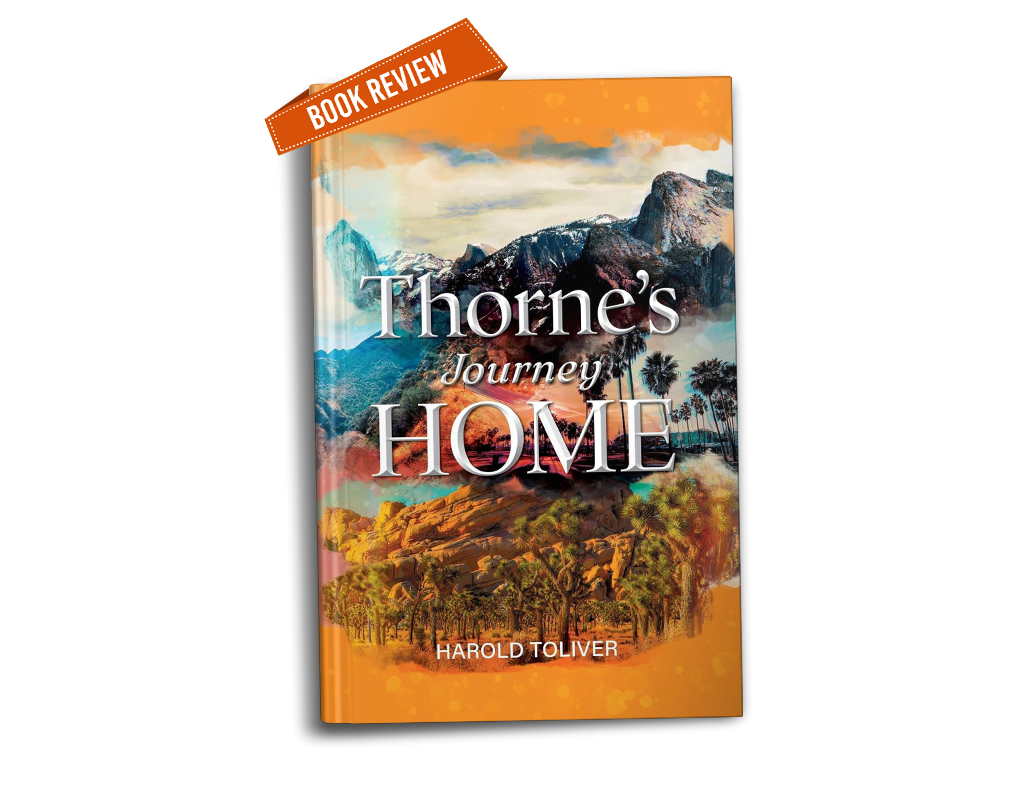
In the wake of the California Gold Rush, prospector “Dante” Thorne lingers in the Southwest while his beloved Molly and brother Weiden journey north towards central Oregon. Wrongly accused of murder, Thorne departs Sacramento hoping to evade the authorities and join Molly and Weiden at their homestead. But his substantial earnings are soon stolen by robbers. Risking his life, Thorne pursues them across rugged country for many days in pursuit of his money.
Thorne’s homeward journey is beset with obstacles: steep ravines, hard frosts, and near-fatal encounters with Native Americans. News of a recent expedition that descended into cannibalism reinforces the sense of an alien land governed by indifferent fates. At the site of a wagon massacre, Thorne discovers two children, a boy and a girl, who survived by hiding behind rocks while their loved ones were slaughtered. Knowing that they’ll die within days if left to themselves in the wilderness, Thorne invites the children to accompany him on the trek north. Food is scarce, and they are at the mercy of the elements, but Thorne is assisted by an old friend, McGantt—a foolhardy but loyal Irishman skilled in the art of survival. Braving forests, canyons, thunderstorms, and encroaching winter, Thorne teaches the orphans to fish, shields them from blizzards, and aids them in navigating treacherous canyons.
Toliver’s novel, one of the best books of recent years, is an American odyssey on par with the works of Larry McMurtry and Cormac McCarthy. Thoroughly rooted in its time and place, it conjures the reality of a West that film and television have hidden beneath layers of mythology. Sublime in its scope, stirring in its details, it can only have been the result of countless hours of research. Toliver is keenly attuned to the landscape of the region: to the sycamores and ash, the “wild roses… on the hilly borderland,” turkey and geese, mossy stones, golden aspen, “wind-stunted trees and tufts of purple mulberry sedge.” Toliver’s attentiveness to the physical nature of the journey lends the story a tactility that makes the orphan’s plight seem all the more desperate.
There is a sense, too, of the antiquity of the continent, of the countless millions of years preceding the arrival of the first American settlers, an air of deep time blowing through the pages of the novel that provides much of its lyricism. “We have been as night travelers,” says one character, “with neither memory of the way nor polestar to guide us.” In a similar way, the book contemplates the perilous situation of Native Americans in a land where they are swiftly receding. When other characters fearfully note native atrocities, Thorne remarks that the white settlers have been just as brutal, and the conflict between them was never a fair one. The settlers, with their weapons, were always destined to win, but the loss of an entire civilization is keenly felt. This is a grand book. Fans of realistic Westerns, thoughtful epics, and the music of American folk band The Handsome Family will rejoice.