
Home » TIPPING POINT FOR A HOLLOW EARTH: How Asimov and Sagan Backed My Prophecy of a Polar Hole Shift to Europe | Reviewed by Nicci Attfield for IndieReader

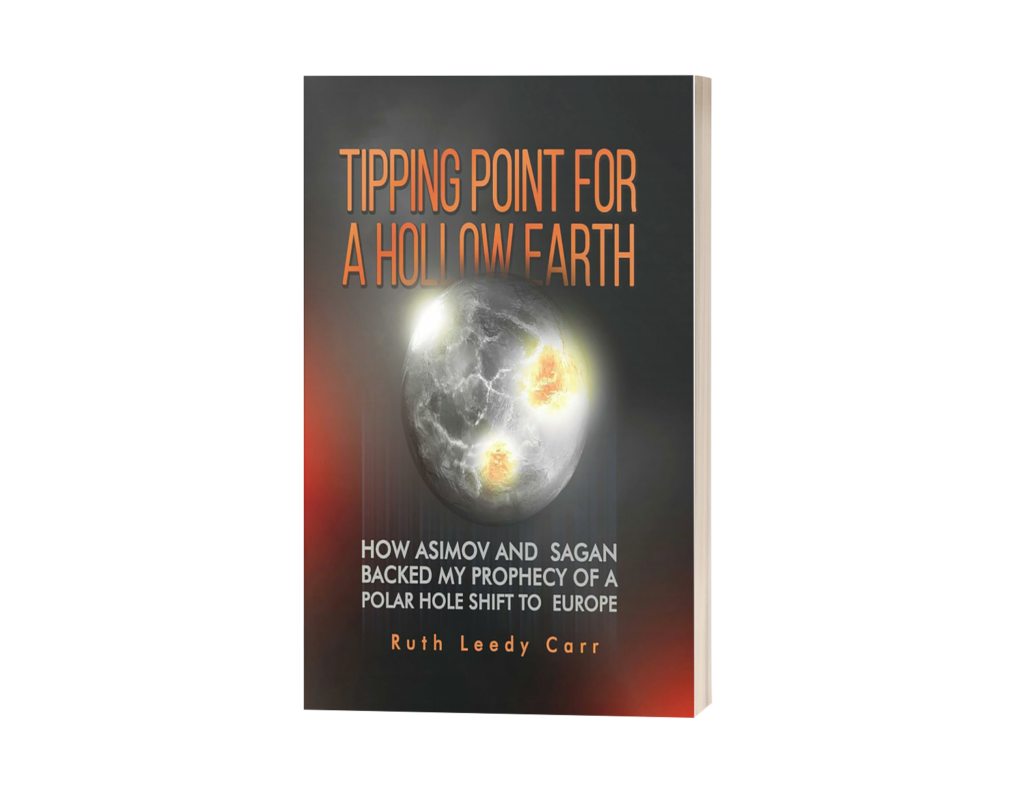
Ruth Carr’s TIPPING POINT FOR A HOLLOW EARTH: How Asimov and Sagan Backed My Prophecy of a Polar Hole Shift to Europe will not convince readers of a hollow Earth, but it does offer a sincere and unusual window into one person’s search for hidden patterns. Carr’s book will be satisfying to readers who wish to explore an outsider’s perspective, as well as the relationship between novels and their value to readers.
In TIPPING POINT FOR A HOLLOW EARTH: How Asimov and Sagan Backed My Prophecy of a Polar Hole Shift to Europe, author Ruth Carr introduces the idea that Earth may be hollow (along with Mars). She presents an array of patterns that include Christ, the Zodiac, a newspaper article, and an article from an anonymous geologist. She shares NASA’s responses to her questions, along with imagined conversations. She also offers interpretations of Cayce’s prophecy of seeing a light in the clouds, and guides us through the history of how the Earth came to be considered solid (alongside Carl Sagan’s writings and Isaac Asimov’s novels).
The book reads more as a personal hypothesis that Carr holds and wishes to share than as a scientific theory. What intrigues the reader most is her decoding of riddles in Asimov’s novels, which she argues places her work in conversation with his and reveals a bond between novelist and theorist: “Addressed in code, Carl Sagan included ‘Earth axis shift’ as well as ‘field reversal’ in the name ‘Stefan Alexeivich Baruda’ in his novel Contact.”
Carr traces Asimov’s work throughout her book, describing how she believes he supported her theory of a hollow Earth and shared that support in his writing. In this way, the link between theorist and writer comes alive, much like the bond between Paul Michel and Foucault in Hallucinating Foucault (though here from the theorist’s perspective, rather than the author’s). The result is an absorbing look at the unique perceived relationship between reader and writer.
Carr presents her ideas with urgency. She believes an Earth axis shift is approaching, that NASA and the news media are staying silent about it, and that Asimov and Sagan left coded guidance for readers. Scientists do not currently support these claims, yet Carr is open about her position. Readers should weigh her hypothesis with that in mind. Even so, the book gives a vivid picture of how convinced Carr is and of how isolating it can feel to hold a view that experts dismiss.
Some of her explanations may strike readers as less plausible. In one passage, Carr writes, “Some sort of chip was evidently placed in his brain enabling an outside actor to beam signals, activating his brain and causing him to speak.” Even so, she conveys what it’s like to stand outside conventional scientific belief and how dismissive professionals can be.
Readers who want laboratory-style evidence may consider this book less suited to them. TIPPING POINT FOR A HOLLOW EARTH is a personal account by a woman who holds a hypothesis that she cannot yet prove and hopes to be heard. It suits readers drawn to how patterns can shape new perspectives, even unproven ones, and to the lived experience of an outlier.
Ruth Carr’s TIPPING POINT FOR A HOLLOW EARTH: How Asimov and Sagan Backed My Prophecy of a Polar Hole Shift to Europe will not convince readers of a hollow Earth, but it does offer a sincere and unusual window into one person’s search for hidden patterns. Carr’s book will be satisfying to readers who wish to explore an outsider’s perspective, as well as the relationship between novels and their value to readers.
PAYMENT METHODS

© 2026 Bookside Press. All rights reserved.